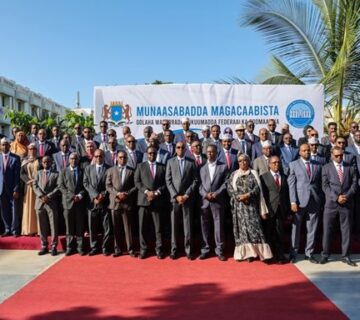
On 16 July 2026, the Council of Ministers of the Federal Republic of Somalia approved the Draft Law establishing the Somali Revenue Authority (SRA), marking a historic milestone in Somalia’s public financial administration.
The proposed Authority represents the first comprehensive national revenue administration institution to be established since the formation of the Somali state. Although the Federal Government of Somalia and the Federal Member States (FMS) had repeatedly recognized the importance of creating a unified national revenue authority, political and institutional challenges resulted in repeated delays to its establishment.
The first formal consensus on creating the Authority was reached in 2018 during the National Consultative Council meeting held in Baidoa (Baydhabo), where the Federal Government and the Federal Member States agreed in principle to establish a unified revenue authority. However, implementation was postponed for several years due to ongoing negotiations over fiscal federalism, revenue-sharing arrangements, and institutional reforms.
The approval of the Draft Law in July 2026 therefore represents the culmination of years of intergovernmental dialogue and cooperation, laying the foundation for a modern, unified, and independent national revenue administration in Somalia.
Although Article 6(1)(g) mandates the Somali Revenue Authority ‘to cooperate with government institutions, including the revenue administration authorities of the Federal Member States and Local Governments, in order to ensure the coordination and integration of the country’s revenue collection system in accordance with the Constitution, its practical implementation is likely to face significant challenges.
The Federal Government of Somalia does not exercise effective control over the entire territory of the country, and intergovernmental relations have frequently been characterized by political disagreements. Over the past decade, tensions between the Federal Government and certain Federal Member States, particularly Puntland and Jubaland, have periodically undermined institutional cooperation. Moreover, Somaliland has operated outside the authority of the Federal Government since its unilateral declaration of independence in 1991.
In addition, in areas where state authority remains limited, Al-Shabaab continues to collect taxes and other forms of revenue, while local militias impose informal levies in some localities. These realities present substantial obstacles to achieving the constitutional objective of a coordinated and integrated national revenue collection system.
Articles 21 and 22 of the Bill on the Establishment of the Somali National Revenue Authority (SNRA) assign the Authority broad responsibilities for the collection of both exclusive federal taxes and concurrent taxes. Under Article 21, the Authority is mandated to collect customs duties, border taxes, taxes on international trade, corporate income taxes on large national and international companies, excise taxes, federal stamp duty, inter-state road user taxes, capital gains tax, revenue derived from natural resources, and other fees established by the Federal Parliament. The Article further recognizes international grants and domestic or foreign loans received in the name of the Federal Government as part of the federal revenue framework.
Article 22 further authorizes the Authority to collect concurrent taxes, including sales tax, personal income tax, property income tax, corporate income tax, professional and business licensing fees, and registration fees for invoices and contracts.
It also requires the Authority to cooperate with the financial authorities of the Federal Member States and Local Governments to prevent overlapping or double taxation and authorizes the conclusion of cooperation agreements to improve the administration of concurrent taxes.
Nevertheless, the practical implementation of these provisions raises important questions. At present, the Federal Government primarily administers and collects federal taxes and customs duties within the Banadir Region. In contrast, the Federal Member States generally collect taxes within their respective jurisdictions, while certain parts of Somalia remain outside the effective control of the Federal Government.
Consequently, it is questionable how the Somali National Revenue Authority will effectively administer and collect all categories of exclusive federal and concurrent taxes throughout the country, as envisaged by the Bill. The successful implementation of these provisions will depend largely on effective cooperation between the Federal Government and the Federal Member States, the conclusion of intergovernmental cooperation agreements, and the gradual expansion of the Authority’s institutional and operational capacity across Somalia.
Structurally, the Bill on the Establishment of the Somali National Revenue Authority is divided into twenty-seven (27) articles arranged under five Parts. Each Part regulates a specific institutional aspect of the proposed Authority, ranging from its establishment and governance to financial administration, revenue collection, accountability mechanisms, and transitional arrangements.
THE STRUCTURE OF THE BILL IS SUMMARIZED AS FOLLOWS
Part 1: Articles 1-6 General Provisions, Establishment, and Functions
This Part establishes the legal framework for the creation of the Somali Revenue Authority (SRA). It defines the Authority’s legal status as an independent federal institution responsible for administering and collecting federal revenues. It also provides key definitions, affirms the Authority’s operational independence while remaining under the policy oversight of the Minister of Finance, and outlines its principal functions, including revenue administration, tax collection, enforcement of revenue laws, taxpayer services, policy advice, institutional cooperation, and revenue modernization.
Part 2: Articles 7-12 Governance and Institutional Management
This Part establishes the governance structure of the National Revenue Authority. It provides for the creation of a Governing Board, defines its composition, responsibilities, meeting procedures, and committee arrangements, and sets out the grounds for appointment and removal of Board members. It also establishes the position of the Director General as the chief executive officer, outlining the qualifications, powers, duties, tenure, appointment process, and circumstances for removal from office.
Part 3: Articles 13-18 Human Resources and Financial Administration
This Part regulates the management of the Authority’s personnel and financial resources. It establishes principles of merit-based recruitment, integrity, confidentiality, conflict-of-interest rules, whistleblower protection, and staff appointments. It further governs the management of public revenue, use of the Treasury Single Account, sources of funding, and preparation of the Authority’s annual budget in accordance with Somalia’s public financial management framework.
Part 4: Articles 19-24 Financial Accountability and Revenue Administration
This Part strengthens accountability and transparency through accounting, auditing, and periodic reporting obligations. It defines the Authority’s mandate to collect federal and shared taxes, identifies the principal revenue laws under its administration, promotes cooperation with Federal Member States in revenue collection, and introduces a reward mechanism for individuals who provide credible information leading to the recovery of unpaid taxes.
Part 5: Articles 25-27 Final and Transitional Provisions
This Part contains the concluding provisions of the draft law. It authorizes the issuance of implementing regulations, provides transitional arrangements for transferring assets, liabilities, and staff from the Ministry of Finance to the National Revenue Authority, and specifies that the law enters into force upon approval by the Federal Parliament, presidential assent, and publication in the Official Gazette.
The Bill on the Establishment of the Somali National Revenue Authority provides a comprehensive legal framework for creating an independent national revenue authority and strengthening Somalia’s public revenue administration. However, its successful implementation will depend on effective cooperation between the Federal Government and the Federal Member States, strengthened institutional capacity, and the gradual extension of effective state authority across the country. Despite the significant political and administrative challenges, the Bill represents an important step toward improving domestic revenue mobilization and advancing Somalia’s fiscal federalism.
No comment