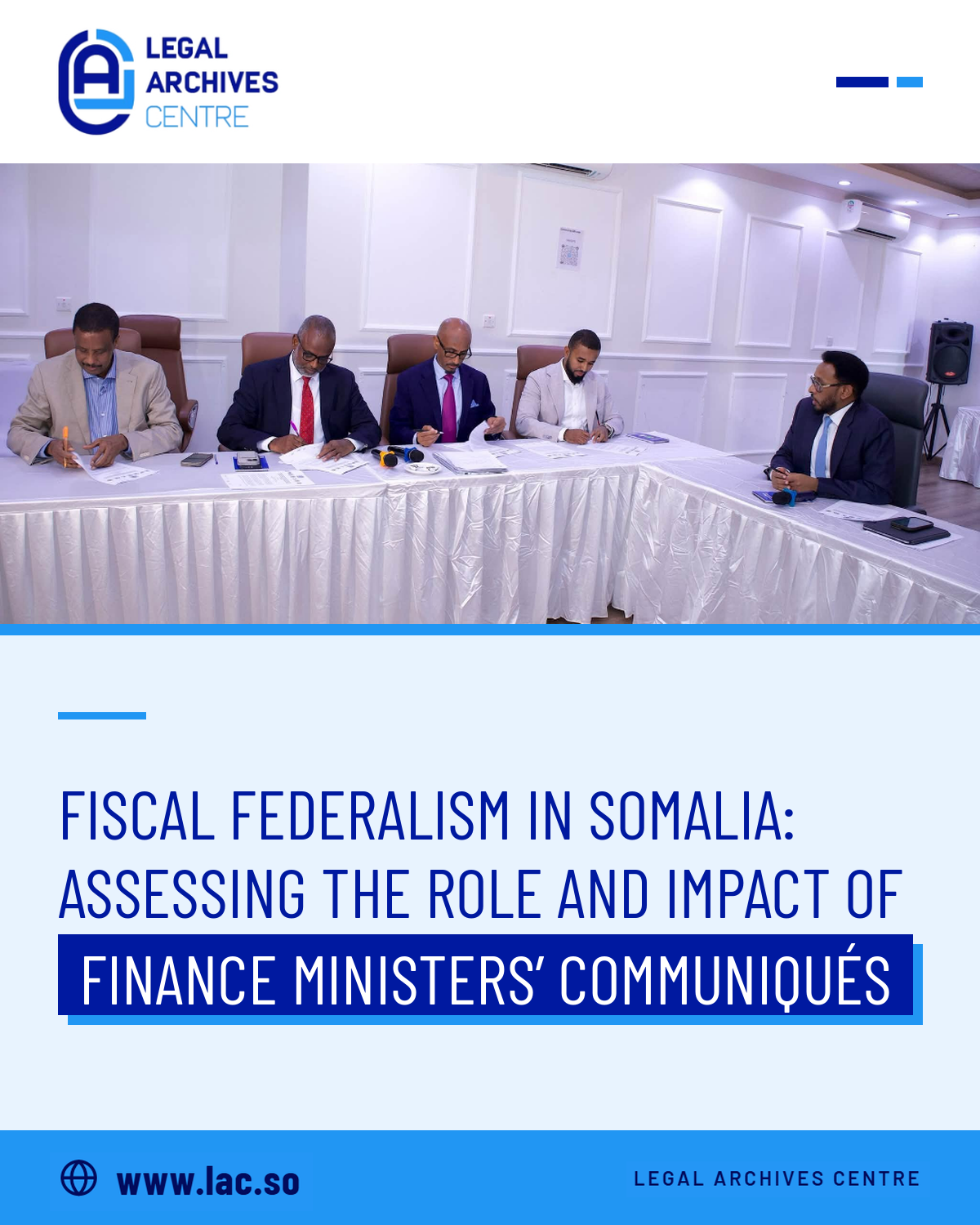
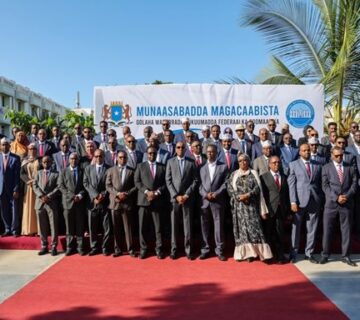
The 25th meeting of the Ministers of Finance of the Federal Government of Somalia, Federal Member States, and Banadir Regional Administration was held at Mogadishu, on 18-19 November 2026. Chaired by the Federal Minister of Finance, the meeting was attended by the Ministers of Finance of the Federal Member States, the Accountant General of the country, the Deputy Governor for Administration and Finance of Banadir Region, and representatives of relevant fiscal institutions.
The meeting focused on strengthening financial systems and cooperation between the two levels of government. It emphasized continued collaboration, implementation of previous agreements, and advancing priorities related to fiscal federalism, while reaffirming national unity, accountability, mutual trust, and consensus.
The key issues discussed and decisions reached during the meeting were as follows:
- Presentation of the Results and Report of the 4th FMS/BRA Self-Assessment for Budget Subsidy Allocation
The meeting reviewed and approved the report and results of the 4th self-assessment of the Federal Member States and Banadir Regional Administration (FMS/BRA), which ranked each administration. The results, submitted by the administrations, were reviewed and verified by the Secretariat and subsequently approved as the basis for allocating budget subsidies.
However, the report does not specify the assessment criteria, indicators, scoring system, points awarded, or evidence supporting the results. It is also unclear what the Secretariat verified. Given that the results determine budget allocations, greater transparency on the assessment methodology and verification process is necessary to establish whether the allocations are objective, measurable, and consistently applied.
2. Finalization of the draft agreement for the implementation of a unified sales tax at the FMS level
The Ministers reviewed the draft agreement on implementing a Unified Sales Tax at the FMS/BRA level, including its purpose, implementation procedures, and administrative responsibilities. After detailed discussion, the meeting approved in principle the unification of the electronic sales tax, to take effect on 1 January 2027, with outstanding technical work to be completed beforehand.
The proposed unification of the electronic sales tax presents significant institutional and implementation challenges. A common system requires harmonized tax laws, administrative procedures, enforcement mechanisms, and institutional capacity across the FMS and BRA. However, while sales-tax collection is more established in Banadir, particularly Mogadishu, other administrations demonstrate limited or inconsistent collection practices. Without addressing these disparities, unification risks remaining a formal arrangement with uneven implementation.
3. Report on the policy for regulating and institutionalizing the work of the country’s finance committee
The meeting reviewed the proposed Intergovernmental Fiscal Federalism Policy Framework and Governance Arrangement, which sets out the operational procedures of the country’s fiscal federalism committee. The framework defines the committee members’ roles and responsibilities, meeting procedures, decision-making processes, and mechanisms for sustaining negotiations on national fiscal matters. The participants agreed to formalize and officially issue the policy, which will subsequently be submitted to the Council of Ministers for approval and implementation.
4. Presentation of a report on embarking on the performance review of the Fiscal Federalism Committee and the Forum of Finance Ministers over the past ten years
Marking ten (10) years of the country’s fiscal federalism committee, the meeting reviewed the proposed performance assessment of the Technical Committee (IGFF-TC) and the Forum of Finance Ministers (FMFF), covering their achievements, challenges, differing positions, and major agreements. The meeting commended the progress made and recommended an independent review to produce a comprehensive report for presentation at the forum’s upcoming meetings.
5. Decision on the budget subsidy allocation for the Federal Member States from the Recurrent Cost and Reform Financing (RCRF) project for the year 2027
The Ministers or the Forum discussed the allocation of the 2027 budget subsidy to the Federal Member States under the Recurrent Cost and Reform Financing (RCRF) Project and agreed that its distribution should be guided by mutual consensus, equity and essential needs. The following arrangements were agreed upon:
5.1 Domestic revenue mobilization: Federal Member States should priorities strengthening and increasing domestic revenue to meet essential expenditure, including salary payments.
5.2 Equal distribution: The 2027 RCRF budget subsidy will initially be distributed equally among the Federal Member States.
5.3 Compliance with conditions: Each Federal Member State must fulfil the requirements governing the use of the allocated funds.
5.4 Redistribution of un-utilized allocations: Where a Federal Member State fails to meet the required conditions, its allocation will be redistributed equally among the other Federal Member States.
5.5 Readiness assessment: The Forum agreed to urgently conduct, in collaboration with the World Bank, a readiness assessment of the North East State (WBS) and Banadir Regional Administration (BRA) to evaluate their eligibility for participating in development projects and facilitate their inclusion as project beneficiaries.
The Forum commended the Office of the Accountant General for its efforts to implement the International Public Sector Accounting Standards (IPSAS), and urged the timely completion of the process.
Having outlined the key decisions and commitments contained in the communiqué, it is now necessary to move beyond a summary of its contents and examine their implications for Somalia’s fiscal federalism. In particular, the central question is whether these recurring communiqués address the underlying institutional, financial and political challenges confronting fiscal relations between the Federal Government and Federal Member States, or primarily record agreements without resolving the issues that impede their implementation.
Evaluating the Role and Influence of Finance Ministers’ Communiqués
Somalia’s Finance Ministers’ communiqués provide a basis for examining inter-governmental fiscal relations and the commitments made to strengthen fiscal cooperation. However, their significance depends not merely on the agreements recorded but also on their implementation and effectiveness in addressing persistent institutional, political and financial challenges within the federal system.
The Legal Authority of the Finance Ministers’ Forum
The Inter-Governmental Fiscal Forum (IGFF), through its Technical Committee (IGFF-TC) and Forum of Finance Ministers (FMFF), provides platforms for fiscal dialogue and negotiation between the Federal Government and Federal Member States. These structures have contributed to inter-governmental cooperation and the development of fiscal federalism in Somalia.
According to the World Bank identifies that the Inter-Governmental Fiscal Forum (IGFF) and the Recurrent Cost and Reform Financing (RCRF) programme as key mechanisms supporting the advancement of fiscal federalism in Somalia.[1]
The recognition at the 25th meeting of a decade of operation of the IGFF-TC and FMFF provides an opportunity to evaluate their institutional performance and practical achievements. Notably, paragraph 3 of the meeting’s preamble reiterates the need to implement agreements reached at previous meetings, indicating that translating intergovernmental commitments into concrete action remains a persistent challenge.[2]
A clearer legal and institutional framework could have provided a stronger basis for the authority of these bodies, enhanced accountability and established more effective mechanisms for ensuring the implementation of intergovernmental agreements.
The Establishment of the Somali Revenue Authority and the Institutionalization of Intergovernmental Fiscal Relations
The Somali Revenue Authority Act 2026 moved through the government and parliamentary approval processes in less than three months. It was approved by the Council of Ministers on 16 July 2026, the House of the People on 9 September, and the Upper House on 21 September, before being signed into law on 7 October 2026.
On 12 November 2026, the Council of Ministers approved the appointment of the Director General of the National Revenue Authority, marking a further step towards establishing its institutional leadership. The Authority builds on the former Directorate General of Revenue under the Ministry of Finance, which was mandated to collect government revenue.
However, its institutional framework extends beyond the appointment of a Director General to include broader governance arrangements, particularly the establishment and composition of a Governing Board, procedures for the appointment and removal of its members, and the allocation of oversight and administrative responsibilities.
Under Article 6(1)(g) of the Somali Revenue Authority act mandates the Authority to cooperate with government institutions, including Federal Member States’ and local governments’ revenue administrations, to coordinate and integrate national revenue collection in accordance with the Constitution. This mandate highlights the need for clear arrangements governing inter-governmental revenue cooperation.
This issue also relates to the 25th Finance Ministers’ meeting, which considered the proposed Intergovernmental Fiscal Federalism Policy Framework and Governance Arrangement. The policy seeks to define the fiscal federalism committee’s responsibilities, meeting procedures and decision-making processes, but remains subject to Council of Ministers’ approval.
The meeting report does not identify the legal instrument establishing the committee or clarify the source and scope of its authority. It is therefore important to distinguish between regulating an existing coordination mechanism and providing its first formal institutional framework.
Parliamentary and Ministerial Overlaps: Challenges to Effective Fiscal Federalism in Somalia
The institutional composition of Somalia’s intergovernmental fiscal negotiations has implications for the respective responsibilities of participating governments. A case in point is Senator Farhan Ali Mahamud, who serves as the Minister of Finance of the Galmudug State Government while simultaneously holding a seat in the Upper House of the Federal Parliament.
At the federal level, the Minister of Finance, Bihi Iman Egeh, also has a background as a Member of Parliament. The Senate has a constitutional responsibility to represent the Federal Member States and safeguard the federal system, whereas state finance ministers are entrusted with managing the financial affairs of their respective administrations. Where parliamentary and executive roles intersect, the legal framework must clearly distinguish legislative representation from executive negotiations and decision-making.
Without such clarity, political agreements and ministerial communiqués may record consensus without establishing sufficiently clear and legally accountable obligations between the participating governments.
Finally, the 25th Finance Ministers’ meeting highlights the continued importance of intergovernmental dialogue in Somalia’s fiscal federalism. However, the recurring call to implement previous agreements demonstrates the persistent gap between negotiated commitments and practical outcomes. The proposed Intergovernmental Fiscal Federalism Policy Framework offers an opportunity to clarify the committee’s responsibilities, decision-making procedures and institutional authority.
The establishment of the Somali Revenue Authority further underscores the need for clear arrangements governing revenue cooperation between the Federal Government and Federal Member States. Issues concerning budget allocations, transparency, institutional authority and overlapping parliamentary and ministerial responsibilities also demonstrate that effective fiscal federalism requires more than regular meetings and policy agreements.
Ultimately, its success depends on clear legal frameworks, political consensus, accountable decision-making and effective implementation of intergovernmental commitments.
[1] World Bank, Somalia Recurrent Cost and Reform Financing (RCRF) Phase III: Results Brief, 2023, pp. 1-2
[2] Legal Archives Center, ‘Fiscal Federal Cooperation in Somalia: Outcomes in 2026’ at https://lac.so/somalia-fiscal-federal-cooperation-2026/?utm_source=chatgpt.com.
No comment