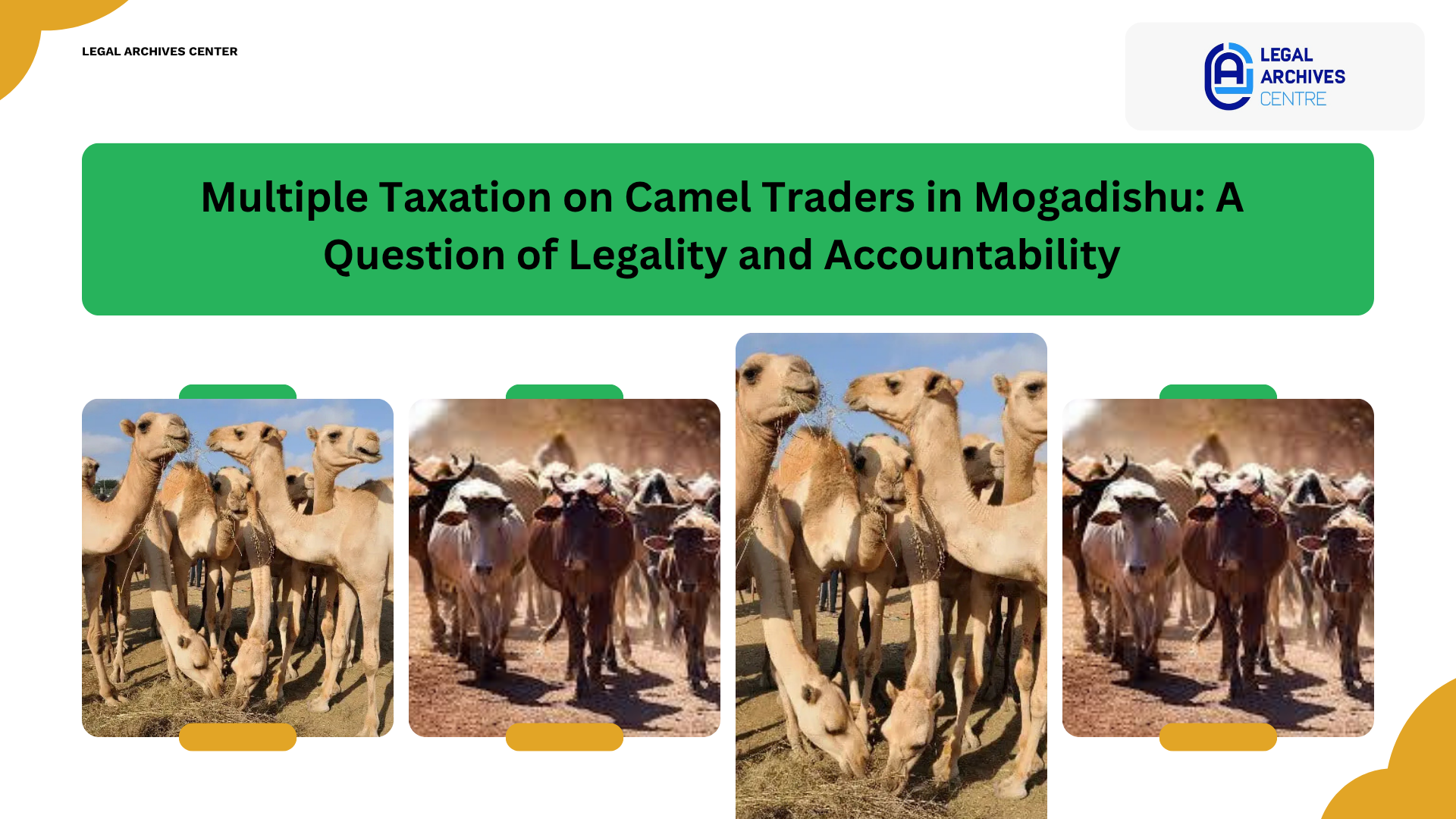
This week, concerns have been raised by both camel traders and importers operating through the Port of Mogadishu. The common grievance expressed by these groups relates to what they describe as excessive taxation and instances of double taxation. According to the traders, these financial charges lack a clear legal foundation and are not grounded in the applicable laws and regulations of the country.
Today, camel traders operating in Mogadishu publicly expressed their dissatisfaction with what they describe as excessive taxation and multiple layers of revenue collection imposed on the livestock sector. During their statement, the traders announced that they would close the camel market tomorrow and suspend the supply of camel meat as a form of protest against the measures they consider unfair and economically burdensome.
According to the traders, the government has historically collected a fee of USD 5 per camel. However, they allege that the amount has recently been increased to USD 7 per camel. While the increase itself has generated concern, the traders maintain that their principal grievance extends beyond the revised government charge. They argue that livestock traders are required to make additional payments to several other authorities and entities throughout the supply chain, resulting in what they characterize as multiple taxation.
The traders further claimed that a camel is subjected to approximately five separate charges before reaching the market. According to their estimates, the cumulative amount paid on a single camel exceeds USD 20, significantly increasing the cost of doing business. In their view, these overlapping charges constitute a form of double taxation or multiple taxation that places an unreasonable burden on traders, consumers, and the broader livestock industry.
The traders emphasized that the livestock sector remains one of the most important pillars of the Somali economy and argued that excessive financial burdens ultimately affect market prices and consumer welfare. They called upon the relevant government institutions to review the existing tax structure, eliminate overlapping charges, and establish a transparent and legally grounded system of revenue collection.
As a result of these concerns, the traders stated that the planned market closure is intended to draw attention to their grievances and encourage dialogue with the authorities regarding the legality, fairness, and economic impact of the taxes and fees imposed on the livestock trade.
On the other hand, businessmen and importers operating through the Port of Mogadishu have expressed concerns regarding the reintroduction of charges associated with the Electronic Cargo Tracking Number (ECTN) system. The traders stated that the issue had previously been raised with the President of the Federal Republic of Somalia in 2023, during which they were reportedly assured that the matter would be resolved. Notwithstanding those assurances, the traders contend that the ECTN charges have resurfaced as of June 2026.
According to their statement, the Electronic Container Tracking Number (ECTN), fee is imposed in addition to existing customs duties, port charges, and other legally recognized taxes and fees. The traders further alleged that the Ministry of Ports and Marine Transport has directed importers to make payments to an international account in connection with the ECTN system. They claim that the amounts charged vary considerably, ranging from USD 100 to USD 300 per container. At the same time, rates reportedly communicated to some importers indicate charges of USD 50 for a 20-foot container and USD 70 for a 40-foot container.
The importers argue that the absence of a uniform and fixed rate structure raises concerns regarding transparency, predictability, and administrative consistency. They further maintain that the charges lack a clear legal basis and are not supported by any publicly identified legislative, regulatory, or institutional instrument authorizing their collection. Consequently, they question the legality of the measure and call upon the relevant authorities to clarify the legal foundation, scope, and administration of the ECTN regime.
Although the grievances arise from different sectors of the economy, both groups raise a common legal concern: whether the disputed taxes, fees, and charges are supported by a clear statutory basis and imposed in accordance with the principles of legality, transparency, and accountability that govern public revenue collection in Somalia.
On 21 August 2024, the Council of Ministers of the Federal Government of Somalia adopted a significant resolution on taxation and public revenue, requiring that all government revenue be deposited and managed exclusively through the Treasury Single Account (TSA). As part of the same resolution, the Council also abolished the previously concluded agreement relating to the Electronic Container Tracking Note (ECTN) system, along with several other charges and arrangements that had generated concerns among traders and businesses.
Legal and Institutional Basis for Revenue Collection
The legality of the taxes, fees, and charges complained of by camel traders and importers must be examined within Somalia’s constitutional and statutory framework governing public revenue collection. In a system governed by the rule of law, government revenue cannot be collected arbitrarily or without legal authority.
A. Constitutional Framework
The constitutional basis for revenue collection in Somalia is found in Article 125 of the Provisional Constitution (2012), which requires the establishment of a National Treasury and mandates that revenue collection be regulated by law. The provision reflects the principle that public revenue must be collected and managed through legally authorized and accountable institutions. Accordingly, the recent complaints concerning multiple taxation and ECTN charges raise an important constitutional question as to whether the disputed payments are supported by a lawful framework governing revenue collection in Somalia.
B. Public Financial Management Act, 2019
The Public Financial Management Act, 2019 provides the principal statutory framework governing the collection and management of public revenue in Somalia. Under Article 4 of the Act, all revenue of the Federal Government must be deposited into and managed through the Treasury Single Account (TSA), while Article 8(2) designates the Ministry of Finance as the institution responsible for the collection, management, and oversight of government revenue. Furthermore, Article 4(3) defines government revenue broadly to include taxes, fees, charges, and fines collected by or on behalf of the Federal Government.
These provisions reflect the principles of transparency, accountability, and centralized revenue administration. In the context of the recent complaints by traders, the Act is particularly relevant because it requires that public revenue be collected through legally authorized institutions and managed in accordance with the national public financial management framework.
C. Revenue Administration Act, 2019
The Revenue Administration Act, 2019 complements the public financial management framework by regulating the administration of government revenue. Article 6(b) of the Revenue Administration Act, 2019 grants the Minister of Finance the authority to establish and amend tariffs, taxes, fees, charges, and fines. This provision ensures that revenue measures originate from a legally designated authority.
While article 108 reinforces the Ministry of Finance’s role in determining tariff schedules and promoting consistency in revenue collection. The provision seeks to prevent overlapping charges and unauthorized revenue measures by different government institutions.
Both articles suggest that taxes, fees, and other compulsory charges must be imposed pursuant to a legally authorized tariff framework. Accordingly, the recent complaints by traders raise questions as to whether the disputed charges were established and collected in accordance with the Revenue Administration Act, 2019.
D. Council of Ministers Resolution of 21 August 2024
The Council of Ministers’ Resolution of 21 August 2024 further strengthened the legal framework governing public revenue collection by reaffirming that government revenue must be managed through the Treasury Single Account (TSA). Of particular relevance to the present controversy, the Resolution expressly abolished the previously concluded agreement relating to the Electronic Container Tracking Services (ECTN/ECTS), together with the container cleaning services agreement and the municipal sanitation services agreement. Consequently, allegations concerning the reintroduction of ECTN-related charges raise an important legal question as to whether such charges are supported by a new lawful authority or are inconsistent with the Council of Ministers’ earlier decision.
Conclusion
At its core, the controversy surrounding the charges imposed on camel traders and importers is a question of legality rather than taxation alone. Under Somalia’s constitutional and statutory framework, taxes, fees, levies, and other compulsory payments must be imposed and collected pursuant to lawful authority. The Constitution, the Public Financial Management Act, 2019, the Revenue Administration Act, 2019, and the Council of Ministers’ Resolution of 21 August 2024 collectively establish a system intended to ensure that public revenue is collected through authorized institutions and managed in a transparent and accountable manner.
The allegations of multiple taxation raised by camel traders, together with the reported reintroduction of ECTN-related charges, therefore warrant careful legal scrutiny. In particular, questions arise as to whether the disputed charges are supported by a valid legal instrument, whether they have been imposed by the competent authority, and whether their collection complies with the broader framework governing public revenue administration in Somalia.
Ultimately, the issue is not whether the government possesses the power to raise revenue. Rather, it is whether that power is exercised in accordance with the law. In a constitutional system founded upon the rule of law, the legitimacy of any tax or charge depends not only on its economic purpose but also on its legal foundation. Transparency, accountability, and adherence to the governing legal framework remain essential to maintaining public confidence in Somalia’s revenue collection system.

No comment