Somalia is facing an unprecedented constitutional crisis: for the first time, two men claim leadership of the Supreme Court. As the apex of the judiciary and a pillar of the rule of law, the Court’s legitimacy has profound implications for the entire State.
On 5 November 2026, Somalia’s Supreme Court declared null and void the Presidency’s 4 November decision removing Chief Justice Baashe Yusuf Ahmed and reinstating his predecessor, Ibrahim Idle Suleiman. The dispute has since left the Court without the quorum required to sit and function.
The crisis traces back to 11 October 2026, when the Supreme Court received a constitutional petition filed by Somalia’s seventh President, Sharif Sheikh Ahmed. The petition raised three principal issues: the constitutionality and validity of the 2026 Constitution; the legality of the incumbent government’s continued tenure, including its unilateral one-year extension, despite having been formed in 2022 under the 2012 Constitution, which prescribed a four-year term rather than the five years provided under the new Constitution.
The petition also sought a declaration that any administrative actions undertaken by the government beyond its constitutionally prescribed term of office should be considered null and void.
On 23 November 2026, former Chief Justice Baashe Yusuf Ahmed issued a letter (MSF/XG/61/2026) to the Speakers of both Houses of Parliament, urging compliance with the Supreme Court’s 5 November 2026 ruling (MS/DST/1/2026). He maintained that their constitutional mandates expired on 14 April 2026 under Article 60 of the 2012 Provisional Constitution and that subsequent amendments introducing a five-year term did not extend the mandates of the incumbent Houses.
The letter called for the suspension of legislative activities, budget approvals and appointments, while reiterating the deadlines of 5 December 2026 for agreeing on an electoral model and 90 days for holding elections. Both Speakers were also asked to respond within seven days, with copies sent to other key federal and state authorities.
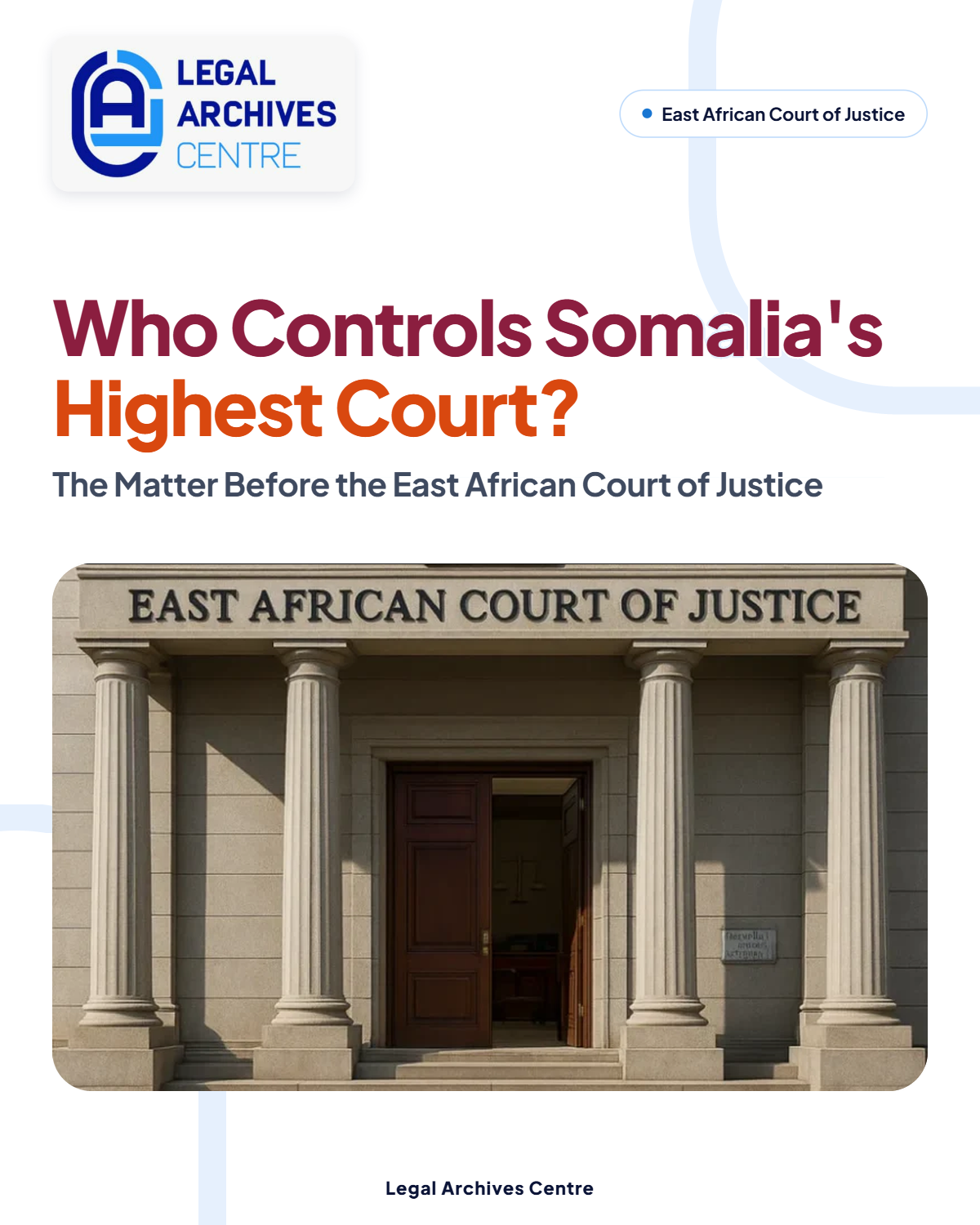
The Dispute Acquires a Regional Judicial Dimension Before the East African Court of Justice
On 18 November 2026, the Registrar of the East African Court of Justice (EACJ), First Instance Division, sitting in Arusha, issued a notification under Rule 26 in Reference No. 69 of 2026. The case was brought by six justices of Somalia’s Supreme Court Baashe Yusuf Ahmed as former Chief justice, Salah Sh. Ibrahim Diblawe, Abdikadir Idiris Essa, Abubakar Ahmed Ali, Abdikafar Hussein Isak and Abdiaziz Mohamed Yusuf against the State Attorney General, representing the Federal Republic of Somalia.
The notification formally served the Government with the Reference and required it to submit a response within 45 days. Failure to do so may allow the Court to hear and determine the case in the Government’s absence.
Reliefs and Remedies Sought Before the East African Court of Justice (EACJ)
Under paragraph 12 of the Reference, the Applicants allege that the conduct of the President, as Head of the Executive Branch of the Respondent State and acting on behalf of the country, violates the fundamental and operational principles of the East African Community, as enshrined in Articles 6(d), 7(2) and 8 of the EAC Treaty.
On this basis, the Applicants seek the following declarations and orders from the Court
On this basis, the Applicants seek several declarations and orders from the East African Court of Justice. First, they ask the Court to declare that the purported removal of the First Applicant as Chief Justice on 4 November 2026, and the subsequent appointment of a replacement, without compliance with the applicable constitutional procedures, violate the Respondent’s obligations under Articles 6(d), 7(2) and 8(1)(c) of the EAC Treaty and the Constitution of Somalia 2026 that spells out the procedure for removal of a judicial officer.
They further seek declarations that intimidation, coercion or retaliation against judicial officers, as well as disregard for judicial independence and binding judicial decisions, are inconsistent with the Treaty principles of the rule of law and good governance.
The Applicants also seek orders requiring the Respondent to bring its conduct into conformity with the Treaty, cease unlawful interference with the First Applicant’s judicial office and take appropriate measures to safeguard the independence and security of the affected judicial officers.
Pending the determination of the Reference, they request interim orders suspending the implementation of the removal and replacement decisions, preserving the constitutional and institutional status quo that existed before 4 November 2026, preventing further interference with the First Applicant’s judicial office and protecting the Applicants’ security, liberty and judicial independence.
In additional prayers concerning the Second to Sixth Applicants, they seek a declaration that the withdrawal of their official security personnel, drivers and protective facilities, where undertaken in retaliation for their judicial functions or in a manner undermining judicial independence, violates Articles 6(d), 7(2) and 8(1)(c) of the Treaty.
They also request the restoration of appropriate security arrangements and interim protection against intimidation, harassment, unlawful surveillance, threats and other retaliatory measures. Finally, the Applicants ask the Court to grant any further orders it considers necessary and to award the costs of the Reference against the Respondent.
The Chief Justice’s Removal and Appointment Under the 2026 Constitutional Framework
Although the adoption and legitimacy of Somalia’s 2026 constitutional framework remain contested, the text establishes specific procedures governing the appointment and removal of the Chief Justice. These provisions are particularly relevant to the dispute because they distribute authority among the Supreme Judicial Council, Parliament and the President, rather than vesting the process in the Presidency alone.
Article 135- Appointment of the Chief Justice: The appointment of the Chief Justice requires nomination by the Supreme Judicial Council, approval by both Houses of the Federal Parliament and formal appointment by the President through a presidential decree. The provision requires the involvement of all three branches of government, a procedure that appears not to have been observed in this case.
Article 138- Removal of the Chief Justice: The removal process requires a formal complaint supported by at least two-thirds of the Supreme Judicial Council, followed by referral to the Speakers of both Houses of Parliament within 15 days. Removal must then be approved through a secret ballot by a majority of the full membership of each House.
Under Article 145 of the new constitutional framework, provides for the establishment of the Supreme Judicial Council and its role in administering the federal judiciary. However, its failure to become operational should not justify the President assuming powers not constitutionally vested in the Presidency. The maxim nemo dat quod non habet– meaning that no one can give what they do not have, reinforces the principle that constitutional powers cannot be assumed without a lawful basis.
Somalia’s Growing Litigation Before the EACJ
Since joining the East African Community, Somalia has increasingly been involved in proceedings before the East African Court of Justice. Within less than three years of its accession, three notable proceedings have emerged.
The first is Abdilahi Hashi Abib v. The Attorney General of the Federal Republic of Somalia, Reference No. 57 of 2025.
The second is Amb. Mohamed Ahmed Awil, Ali Abdulnour Osman, Abdullahi Mohamed Ahmed and the Attorney General of the Federal Republic of Somalia with Secretary General of the East African Community, Application No. 3 of 2025 in the Matter of Appeal No. 2 of 2025.
The third is Hon. Justice Bashe Yusuf Ahmed & 5 Others v. The State Attorney General of Somalia, Reference No. 67 of 2026, before the First Instance Division. All these proceedings demonstrate Somalia’s emerging engagement with the EACJ and the growing regional judicial dimension of disputes involving its constitutional and institutional affairs.
Ultimately, Somalia’s overlapping disputes over political mandates and Supreme Court leadership raise fundamental questions about constitutional legitimacy and the rule of law. Regional concerns expressed by the Uganda Law Society and East Africa Law Society, alongside proceedings before the East African Court of Justice, underscore the wider implications. Constitutional supremacy must apply equally to all institutions and public officeholders, without exception.

No comment