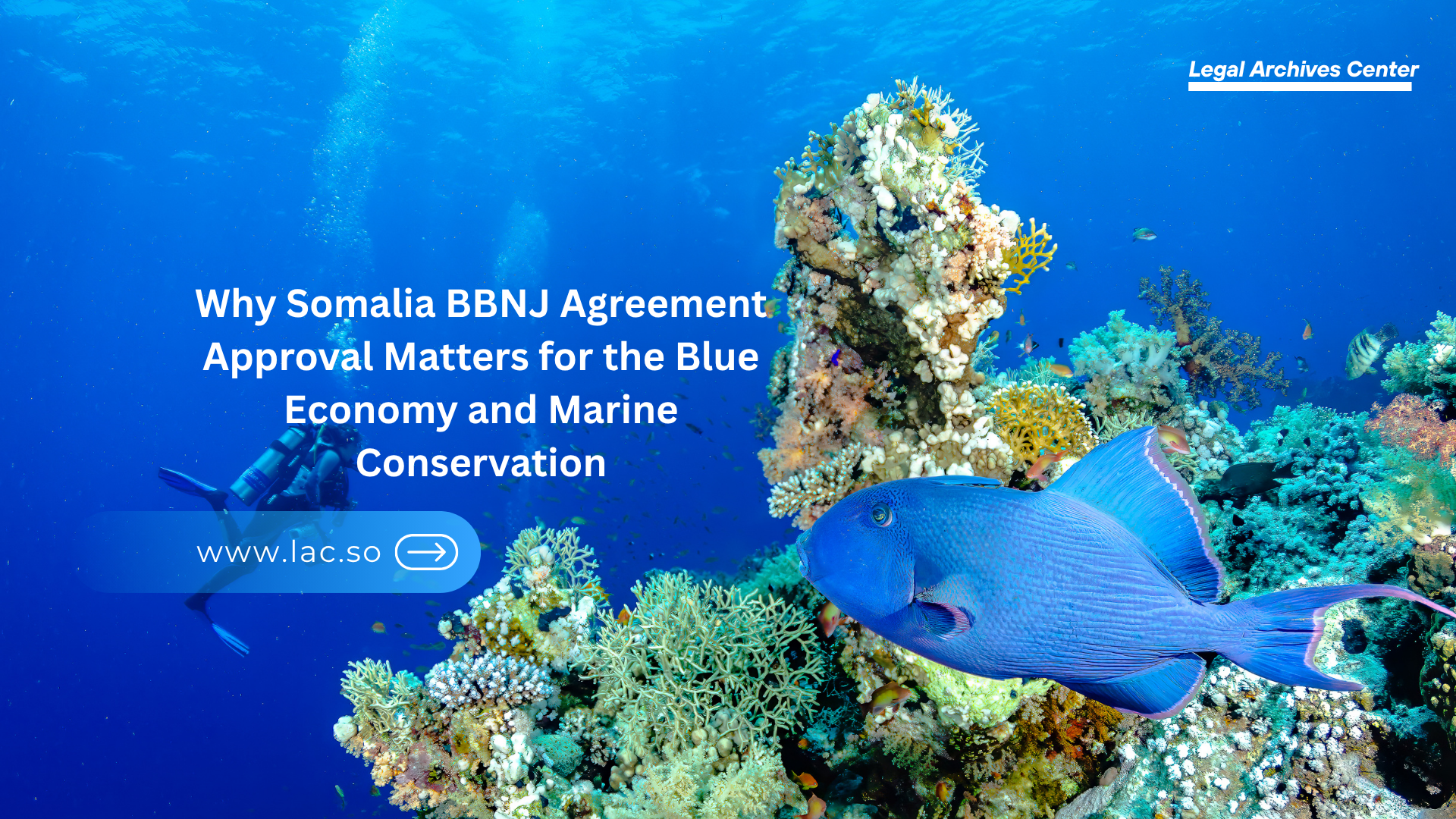
On 23 April 2026, the Council of Ministers of the Federal Government of Somalia, during its weekly meeting, approved an agreement adopted under the framework of the UNCLOS concerning the conservation and sustainable use of marine biodiversity in areas beyond national jurisdiction (BBNJ Agreement). This development marks a pivotal moment in Somalia’s engagement with contemporary ocean governance and reflects a deliberate shift toward integrating international environmental obligations with national economic priorities.
The approval of the BBNJ Agreement is particularly significant when viewed through the lens of Somalia’s emerging blue economy strategy. As a coastal state endowed with one of the longest shorelines in Africa, Somalia possesses substantial yet underutilized marine resources. The decision to align with this global legal framework underscores a recognition that sustainable economic growth in marine sectors such as fisheries, maritime trade, and marine biotechnology must be grounded in robust conservation principles and international cooperation.
At the same time, the endorsement highlights Somalia’s commitment to strengthening marine environmental protection beyond its national jurisdiction. Marine ecosystems are inherently interconnected, and pressures on biodiversity in the high seas directly affect coastal states. By supporting the BBNJ regime, Somalia contributes to global efforts aimed at preserving ecological balance, promoting sustainable use of ocean resources, and addressing emerging challenges such as overexploitation, climate change, and biodiversity loss.
Accordingly, this development is not merely a formal legal step but a strategic policy choice that positions Somalia at the intersection of environmental stewardship and economic transformation. It reflects an evolving approach in which marine conservation and blue economy development are treated as mutually reinforcing objectives within the broader framework of international law.
Understanding the BBNJ Agreement in Context
The BBNJ Agreement is an implementing instrument under UNCLOS, designed to operationalize its broad environmental obligations. While UNCLOS established foundational principles for ocean governance, it did not comprehensively regulate biodiversity in ABNJ. The BBNJ Agreement fills this gap through four key pillars:
- Marine Genetic Resources (MGRs) and benefit-sharing
- Area-Based Management Tools (ABMTs), including Marine Protected Areas
- Environmental Impact Assessments (EIAs)
- Capacity Building and Transfer of Marine Technology. These components collectively create a governance structure that balances exploitation with conservation, ensuring that marine resources are utilized sustainably and equitably.
Relevance to Somalia’s Blue Economy
Somalia’s blue economy remains underdeveloped despite its vast marine resources. Fisheries, maritime transport, offshore energy, and marine biotechnology represent untapped sectors with high economic potential. The BBNJ Agreement provides a legal and institutional framework that can support: Sustainable fisheries management through ecosystem-based approaches, access to marine genetic resources for scientific and commercial use, participation in international benefit-sharing mechanisms and attraction of environmentally responsible investment. By adhering to internationally recognized standards, Somalia can enhance investor confidence and integrate into global value chains linked to marine resource.
Enhancing Governance and Institutional Capacity
A critical challenge facing Somalia’s maritime sector is limited institutional capacity. The BBNJ Agreement addresses this through provisions on capacity building and technology transfer. These including training in marine scientific research, development of monitoring and enforcement systems, access to advanced marine technologies and strengthening legal and regulatory frameworks. Such measures can significantly improve Somalia’s ability to govern its maritime domain effectively, bridging gaps between policy and implementation.
Strengthening Environmental Impact Governance
The Agreement introduces more robust requirements for environmental impact assessments (EIAs) for activities in ABNJ. This has broader implications for environmental governance by promoting precautionary and ecosystem-based approaches, enhancing transparency and accountability in marine activities and setting higher environmental standards that may influence national practices. For Somalia, adopting such standards can improve domestic environmental regulation and reduce ecological risks associated with maritime activities.
Challenges and Implementation Considerations
While Somalia’s approval of the BBNJ Agreement under the UNCLOS represents a forward-looking legal and policy commitment, its practical realization will depend on the country’s ability to address a range of structural, legal, and institutional challenges. Translating international obligations into effective national action requires not only legislative alignment but also sustained political will, technical capacity, and resource mobilization.
Harmonization of National Legal Frameworks: one of the foremost challenges lies in aligning Somalia’s domestic legal system with the obligations arising from the BBNJ Agreement. Existing maritime, environmental, and fisheries laws may not yet fully reflect contemporary standards on biodiversity conservation, environmental impact assessments, or benefit-sharing mechanisms.
This process will require a comprehensive review of national legislation, including fisheries laws, environmental protection statutes, and maritime regulations, integration of new legal concepts such as marine genetic resources (MGRs), area-based management tools (ABMTs), and high seas governance and clarification of jurisdictional mandates between federal and state-level authorities, particularly in light of Somalia’s federal structure.
Institutional Coordination and Governance Complexity: Effective implementation of the BBNJ Agreement under the UNCLOS requires strong coordination across government institutions. In Somalia, however, marine governance responsibilities are divided primarily between the Ministry of Environment and Climate Change and the Ministry of Fisheries and Blue Economy resulting in overlapping mandates that have already created practical coordination challenges in relation to BBNJ matters.
This institutional tension is not merely structural but has had direct procedural implications. For a considerable period, the submission of the BBNJ Agreement to the Council of Ministers was delayed due to disagreements between the two ministries over which institution held the authority to formally present the instrument. This jurisdictional uncertainty slowed decision-making and illustrates the broader governance gap within Somalia’s ocean policy framework. It was only shortly before the recent approval that this impasse was resolved, allowing the Agreement to be tabled and ultimately endorsed by the Council.
Substantively, the overlap arises because the Ministry of Environment and Climate Change is responsible for environmental protection and biodiversity conservation, while the Ministry of Fisheries and Blue Economy oversees resource utilization and economic development of marine sectors. The BBNJ Agreement inherently bridges these domains, particularly in areas such as environmental impact assessments, marine genetic resources, and area-based management tools. In the absence of clearly defined institutional boundaries, this intersection risks duplication of functions, inconsistent policy approaches, and fragmented implementation.
These challenges are further exacerbated by weak inter-agency communication, limited data-sharing systems, and the absence of a centralized coordinating authority for ocean governance. Consequently, policy execution may become inefficient, and Somalia’s ability to meet its international obligations could be undermined.
Addressing these issues requires the establishment of a formal coordination mechanism, such as an inter-ministerial task force or a national ocean governance body, with a clear mandate to oversee BBNJ implementation. In parallel, legal and administrative measures should be adopted to clarify institutional roles and reduce jurisdictional ambiguity. Strengthening institutional coherence will be critical to ensuring that Somalia can implement the Agreement in an effective, consistent, and unified manner.
Scientific Capacity and Data Limitations: the BBNJ framework is heavily reliant on scientific knowledge, particularly in areas such as environmental impact assessments, biodiversity monitoring, and marine spatial planning. However, Somalia currently faces significant constraints in marine scientific research capacity.
Key gaps include limited baseline data on marine ecosystems and biodiversity, insufficient research infrastructure, including laboratories and monitoring systems and shortage of trained marine scientists and technical experts
To address these limitations, Somalia will need to invest in scientific capacity building, potentially leveraging international cooperation mechanisms provided under the BBNJ Agreement. Partnerships with universities, regional organizations, and international research institutions will be essential.
Financial and Resource Constraints: implementation of the Agreement will require substantial financial resources. Activities such as conducting environmental assessments, establishing monitoring systems, and participating in international governance processes involve significant costs.
Engagement of Local Communities and Stakeholders: Coastal communities in Somalia are heavily dependent on marine resources for their livelihoods, particularly through small-scale fisheries. Effective implementation of the BBNJ Agreement must therefore take into account the socio-economic realities of these communities.
Enforcement and Monitoring Challenges: Even with appropriate laws and policies in place, enforcement remains a critical challenge. Monitoring activities in vast maritime spaces, particularly in areas beyond national jurisdiction, requires advanced technology and coordination with international partners.
Federal Structure and Governance Dynamics: Somalia’s federal system introduces additional complexity in implementing international agreements. Responsibilities over natural resources, including marine resources, may be shared or contested between federal and state authorities.
Integration with Broader Development and Climate Policies: The objectives of the BBNJ Agreement intersect with broader national priorities, including climate adaptation, food security, and economic development. Ensuring policy coherence across these areas is critical.
This requires:
- Integration of marine conservation into national development plans
- Alignment with climate strategies such as Nationally Determined Contributions (NDCs)
- Coordination with blue economy policies and sectoral strategies. A holistic approach will help maximize synergies and avoid policy fragmentation.
Conclusion
Somalia’s approval of the BBNJ Agreement under the UNCLOS represents a significant and strategic step toward aligning national priorities with evolving international ocean governance. As highlighted throughout this analysis, the decision is not merely a formal endorsement but a reflection of Somalia’s broader ambition to harness its marine resources in a sustainable and economically productive manner.
The Agreement offers a comprehensive framework that integrates biodiversity conservation with the sustainable use of marine resources, thereby directly supporting the development of Somalia’s blue economy. It creates opportunities for enhanced scientific cooperation, equitable benefit-sharing, improved environmental governance, and increased participation in global decision-making processes concerning the high seas. At the same time, it strengthens Somalia’s commitment to protecting marine ecosystems that are vital for both national livelihoods and global ecological balance.
However, as the preceding discussion demonstrates, the effectiveness of this commitment will ultimately depend on implementation. Structural challenges particularly those related to legal harmonization, institutional coordination, scientific capacity, and resource constraints must be addressed with deliberate and sustained effort. The recent delays caused by overlapping mandates between key ministries further underscore the urgency of establishing clear institutional frameworks and coordination mechanisms to avoid fragmentation and inefficiency.
In this regard, Somalia’s path forward requires a holistic and integrated approach. Strengthening institutional coherence, investing in capacity building, engaging local communities, and aligning the BBNJ framework with broader development and climate policies will be essential to translating legal commitments into tangible outcomes.
Ultimately, if effectively implemented, the BBNJ Agreement has the potential to serve as a transformative instrument for Somalia supporting long-term economic growth, reinforcing environmental sustainability, and positioning the country as an active and responsible participant in global ocean governance.
No comment