
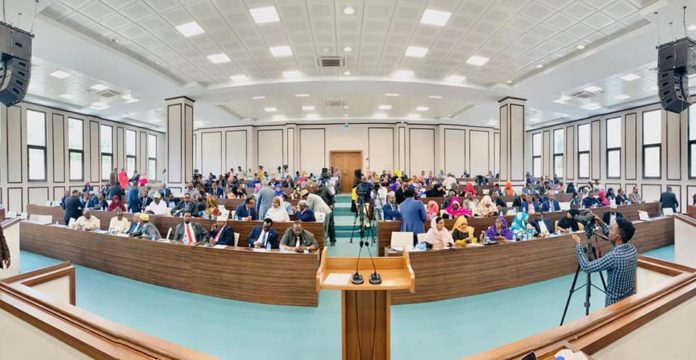
In every sovereign State, the legislature is the principal authority competent to make and amend laws and to approve international instruments before the State becomes bound by them.[1] These powers determine the legal obligations that apply within the country and those the State assumes towards other states and international organizations.
Somalia has adopted a federal system, and its Federal Parliament accordingly consists of two Houses: The House of the People and the Upper House.[2] The two Houses do not, however, hold the same powers in relation to international law. The domestication and incorporation of international instruments into the national legal order rest with the House of the People alone, which represents all the people of Somalia and is the body that approves treaties proposed by the Council of Ministers.[3] The Upper House, which represents the Federal Member States, does not share this function.
- The Rules of Procedure of the House of the People (National Assembly) 2022
Article 110 defines an international treaty as a written agreement between states and international organizations, governed by international law, and it excludes bilateral treaties from its scope, so the procedure applies to multilateral instruments only.[4] Before a treaty is tabled, it must be translated into the Somali language and accompanied by a copy of the original text, which allows members to examine it in a language they work in while keeping the authentic text available for comparison.[5] The Council of Ministers then submits the treaty to the House of the People for approval.[6]
- Foreign Affairs Committee as a Parliamentary Scrutiny Mechanism
On submission, the treaty is referred to the Foreign Affairs Committee, which may seek the assistance of the committee whose subject matter concerns the treaty.[7] The Committee examines the treaty paragraph by paragraph and prepares a recommendation that it be approved or rejected. The recommendation may include a reservation on particular provisions, but the treaty itself may not be amended.[8]
The Committee then submits its recommendation to the House, which schedules it for a second reading, debates the recommendation and the paragraphs of the treaty, and votes on whether to adopt the recommendation. At this stage the recommendation may be amended, but the treaty may not.[9] Once the recommendation is approved, it goes to a third reading for final approval, after which a resolution is issued,[10] and the Speaker notifies the ministers of that resolution.[11]
The effect of Article 110 is that Parliament may approve or reject a treaty, with the possibility of reservations, but may not amend its text. This is consistent with the nature of treaties as instruments negotiated with other parties, which a legislature cannot rewrite unilaterally. At the same time, the article gives the House a substantive role: it scrutinizes the treaty in committee, debates it in plenary, and decides through a three-stage process whether Somalia will be bound. In this respect it gives practical effect to the principles of accountability and separation of powers in Article 3(4) of the Provisional Constitution.[12]
To sum up: The House of the People plays a substantive role in approving international treaties. A treaty submitted by the Council of Ministers is examined by the Foreign Affairs Committee, debated at second reading, and finally approved at third reading by resolution. The House may approve or reject a treaty, with reservations, but may not amend its text. This procedure gives practical effect to accountability and the separation of powers, since the executive proposes treaties and the legislature decides whether the State will be bound.
The value of these rules, however, depends on their application. Treaties that require parliamentary approval must pass through the full procedure before the State becomes bound, otherwise the House’s power of approval remains a rule on paper rather than an effective check on the State’s international commitments
[1] See article 69 the power of parliament under the 2012 constitution
[2] Federal Republic of Somalia, Provisional Constitution of the Federal Republic of Somalia (2012), art. 55(1).
[3] art. 90(q).
[4] The Rules of Procedure of the House of the People (National Assembly) 2022, art. 110(1).
[5] Ibid., art. 110(2)
[6] Ibid., art. 110(3).
[7] Ibid., art. 110(4).
[8] Ibid., art. 110(5).
[9] Ibid., art. 110(6).
[10] Ibid., art. 110(7).
[11] Ibid., art. 110(8).
[12] Provisional Constitution, art. 3(4).

No comment