
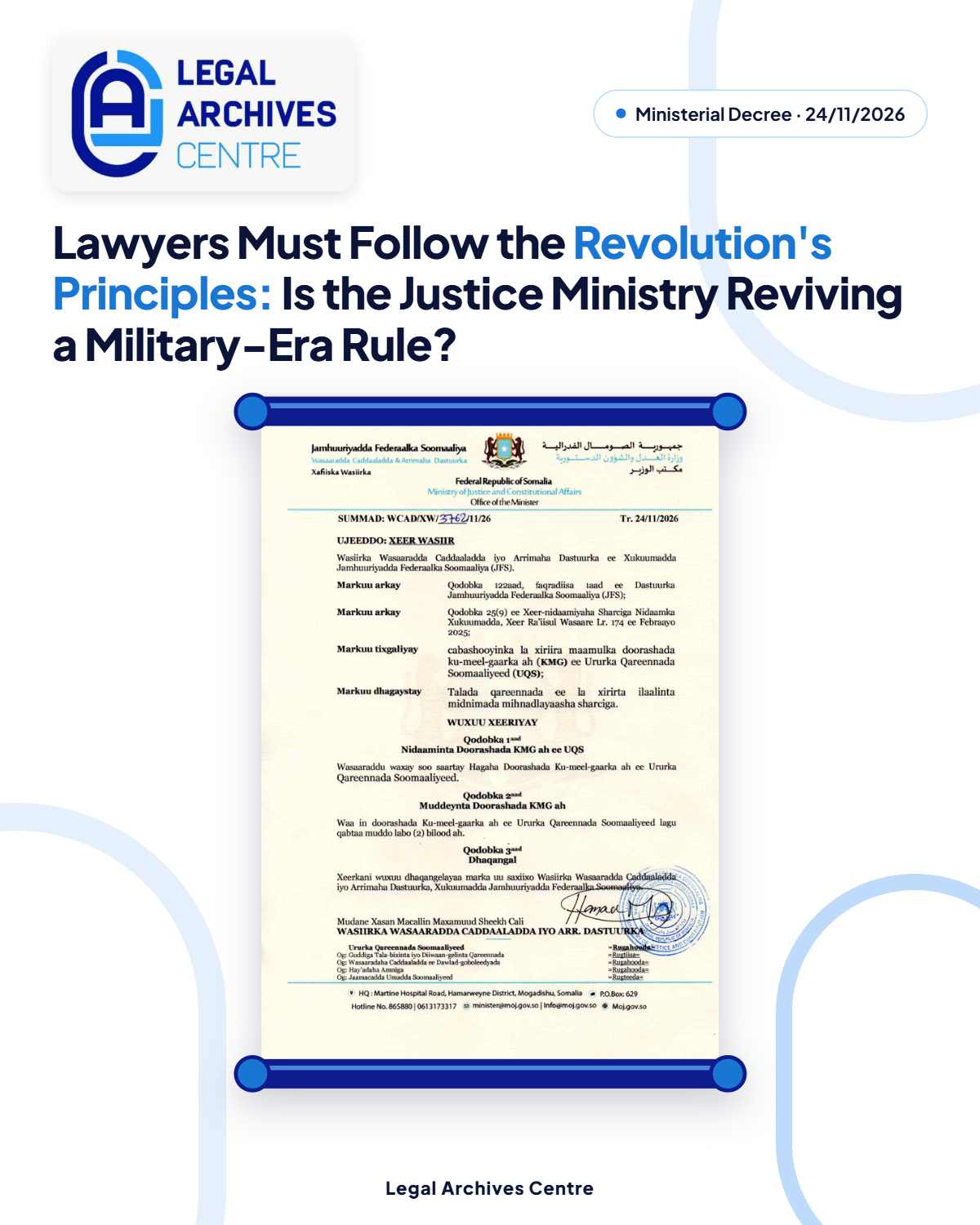
The Minister of Justice and Constitutional Affairs of the Federal Government of Somalia has intervened in the administration of the Somali Bar Association by issuing a ministerial decree establishing an interim leadership for a period of two months, beginning on 24 November 2026.
The intervention came barely hours before the scheduled election of the Association’s leadership, which was expected to take place on 25 November 2026. The election was intended to allow lawyers themselves to determine, through a competitive electoral process, who would lead their professional association.
According to the Somali Bar Association’s Election Committee, 496 lawyers were registered as eligible voters. The election was scheduled to determine the composition of the Association’s 22-member Central Council and fill the offices of Vice-President, for which three candidates had submitted their nominations, and Secretary-General, for which four candidates had been nominated.
The election represented a historic milestone in the institutional development of the Somali Bar Association, offering lawyers an opportunity to elect their representatives through a transparent, free and fair process. Since the Association’s leadership was selected in 2014, no comparable competitive election had taken place. However, the Minister of Justice’s intervention on the eve of the scheduled vote disrupted this long-awaited opportunity for democratic leadership renewal.
The timing of the government’s intervention is particularly concerning. The electoral process had been underway for approximately seven months, encompassing voter registration and candidate nominations, without apparent government interference. However, when lawyers were about to cast their votes, the Ministry of Justice intervened and announced an interim administration.
Why did the government wait until the eve of the election to intervene? If there were legitimate legal, administrative or procedural concerns regarding the electoral process, why were these concerns not addressed during the preceding seven months? The timing creates a reasonable basis for questioning whether the intervention was genuinely intended to resolve an institutional problem or whether it effectively displaced a process through which lawyers were about to exercise their professional self-governance.
There are also allegations surrounding the political circumstances of the election. Somali Streams, a local media outlet, reported concerns involving one of the six individuals contesting the Association’s leadership, who was reportedly associated with representing the former President of Somalia, Sharif Sheikh Ahmed, in a constitutional petition.
The deeper concern is that the government may prefer an Association leadership aligned with its political agenda rather than one independently chosen by the legal profession. Such a possibility would be fundamentally incompatible with the principle that lawyers must be free to represent their clients, challenge government decisions and defend constitutional rights without fear of political retaliation.
The issue also brings renewed attention to the historical relationship between the Somali state and the legal profession. Article 6(b) of the 1975 Advocates Law provides that an advocate must be a person who conforms to the Principles of the Revolution. This provision reflects the political and ideological environment in which the legislation was enacted. Its relevance today raises serious questions about the extent to which the legal profession has moved beyond the political control historically exercised over lawyers.
It is regrettable that the Ministry of Justice appears to be relying on a legal framework containing such a provision to justify its intervention in the affairs of the Bar Association. Somalia should be moving towards a professional legal system in which advocates are independent practitioners, not political supporters of the government or subordinate officers serving the interests of the executive.
The Bar Association’s independence is a fundamental safeguard for the administration of justice. Lawyers defend fundamental rights, challenge unlawful government actions and promote constitutional accountability. Executive interference in their professional association therefore threatens not only lawyers’ autonomy but also the integrity of the wider justice system.
The legal framework for freedom of association and professional independence
The independence of the Somali Bar Association should be understood within the broader legal framework governing freedom of association, professional autonomy and organizational self-governance in Somalia.
Both Somalia’s constitutional framework and its national labour legislation recognize the importance of freedom of association, including the right of individuals to organize, establish professional and representative bodies, and participate in their administration. These principles are further reflected in the country’s wider legal framework governing professional organizations and collective representation.
At the international level, the same protections are recognized under Article 22 of the International Covenant on Civil and Political Rights, Article 8 of the International Covenant on Economic, Social and Cultural Rights, and ILO Convention No. 87 on Freedom of Association and Protection of the Right to Organise. Particularly relevant are the United Nations Basic Principles on the Role of Lawyers (1990), which recognize the right of lawyers to establish independent professional associations, elect their governing bodies and administer their affairs without external interference.
The right to freedom of association is further protected under Article 10 of the African Charter on Human and Peoples’ Rights (1981), which guarantees every person the freedom to form and participate in associations and prohibits any form of coercion compelling an individual to join an association.
Accordingly, the decision of the Ministry of Justice constitutes an administrative act whose legality and validity may be subjected to judicial review before the competent court. Where such an act is found to be unlawful, it may be set aside or annulled in accordance with the applicable law.
Judicial intervention is therefore essential to safeguard the institutional independence of the Bar Association and its legally protected autonomy in regulating its internal affairs. The legal profession is founded not merely upon legal knowledge and professional qualification, but equally upon the courage and professional responsibility to uphold the rule of law, protect justice, and defend the independence and integrity of the legal profession.

No comment