
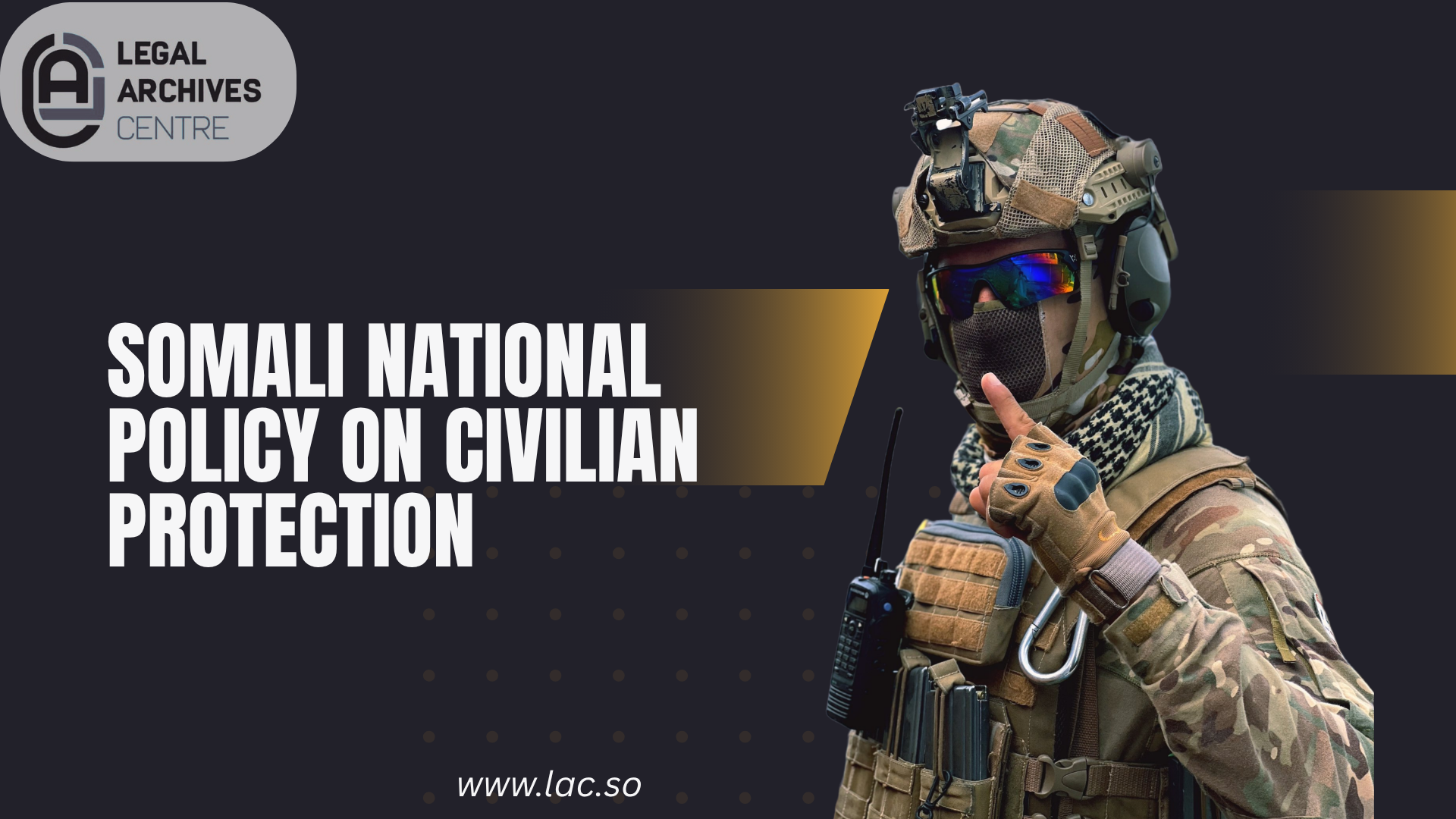
On 2 April 2026, Somalia adopted a National Policy on the Protection of Civilians during Military Operations and Armed Conflict, marking a significant milestone in the country’s transition from externally supported security arrangements to full national ownership of security governance.
In parallel with these developments, on 4 December 2025, the Council of Ministers of the Federal Republic of Somalia also approved the Additional Protocols to the Geneva Conventions of 12 August 1949, thereby reinforcing Somalia’s commitment to the development and progressive application of International Humanitarian Law.
Somalia stands at a critical stage in state-building and in the transition of its security sector. The national security forces have fully assumed responsibility for the country’s security and the stabilization of areas liberated from terrorist groups. The Ministry of Defence, emphasizes that the protection of civilians is both a constitutional obligation of the state and a moral responsibility.
The National Policy on the Protection of Civilians reflects a unified commitment by national security institutions to ensure that all security operations are conducted with the highest level of precaution and professional competence, grounded in legality, in order to safeguard and uphold the lives of civilians. This policy establishes an integrated national framework aimed at preventing harm to civilians, while strengthening institutional coordination and enhancing cooperation between communities and security forces, in accordance with national laws and international legal standards (as page 2 reads).
Objectives and Strategic Orientation of the Policy
The policy establishes a comprehensive framework aimed at integrating civilian protection into all phases of military operations. Its strategic objectives include:
i. To establish a national policy framework for the Armed Forces that is capable of ensuring the protection of civilians during military operations or situations of armed conflict, in accordance with national laws, International Humanitarian Law (IHL), and the objectives of stabilization efforts.
ii. To develop joint procedures and coordination mechanisms involving both civilian and military actors, led by the Ministry of Defence in collaboration with relevant institutions responsible for implementing this policy.
iii. To strengthen compliance with legal obligations regarding the training of security forces on civilian protection, International Humanitarian Law (IHL), and the mitigation of harm to civilians.
iv. To enable the Ministry of Defence to harmonize training systems by implementing the national policy on civilian protection in accordance with national legal frameworks (Sharia, customary law, and statutory law), as well as International Humanitarian Law (IHL) and International Human Rights Law (IHRL).
v. To establish a national network for early warning and rapid response (Early Warning and Response Network – EWRN), aimed at managing risks faced by civilians. This includes public information systems, early warning structures, and community communication channels to ensure transparency, accountability, and direct cooperation between communities and security institutions.
vi. To prioritize the protection and well-being of vulnerable groups (children, women, the elderly, and persons with special needs) in accordance with national and international legal frameworks.
vii. To strengthen the Civilian Harm Mitigation, Tracking, and Response Unit (CHMTRU) within the Ministry of Defence, which is responsible for monitoring, analyzing, and providing appropriate responses to civilian harm occurring during security operations or armed conflict.
The Policy has a Five-Pillar Framework
The operational core of the policy is structured around five interrelated pillars: Civil-Military Coordination (CIMIC) ensuring effective collaboration between security forces and civilian actors; Civilian Engagement and Risk Communication including early warning systems (EWRN); Protection of Vulnerable Groups focusing on targeted safeguards; Monitoring, Accountability, and Enforcement ensuring compliance and corrective action; and Institutionalization and Sustainability embedding the policy into long-term governance structures.
Application of the Policy to Foreign Peacekeeping Forces and International Partners
The policy expressly applies to joint and internationally supported operations and explicitly encompasses Somalia’s security partners, including AUSSOM. In particular, it provides that its scope extends to all security operations conducted by Somali forces independently, as well as those carried out jointly with partner states or with international support. By doing so, the policy ensures that foreign actors engaged in security cooperation within Somalia are not operating outside the national regulatory framework governing the protection of civilians (see Policy, p. 10).
Moreover, the policy goes further by expressly identifying Somalia’s international security partners such as AUSSOM and other bilateral and multilateral actors as stakeholders in its implementation. This inclusion reflects an intentional effort to integrate external forces into a Somali-led system of civilian protection, thereby reinforcing coherence, coordination, and accountability across all actors involved in security operations. (see Policy, p. 10).
Importantly, while the policy brings foreign peacekeeping forces within its scope of application, it does so without displacing the primary responsibility of the Somali state. Instead, it situates international actors within a supportive and coordinated role, requiring them to align their conduct with national policy standards and applicable international legal obligations, particularly those relating to the protection of civilians during armed conflict. (see Policy, p. 10).
Primary Versus Supporting Responsibility
Despite the inclusion of international actors within its scope, the policy places clear emphasis on Somali institutional leadership and national ownership of security operations, particularly within the broader context of the security transition following the drawdown of ATMIS and the establishment of AUSSOM (see Policy, pp. 6-7).
This is further reinforced by provisions indicating that the policy applies to all operations conducted by Somali forces, whether independently or jointly with international partners, within a nationally coordinated framework (see Policy, p. 10). Accordingly, although international actors are included within the scope of the policy, its structure indicates that civilian protection is exercised within a Somali-led legal and institutional framework, particularly under the coordination of national authorities such as the Ministry of Defence (see Policy, p. 10).
Legal and Operational Obligations of Foreign Forces
Foreign peacekeeping forces operating in Somalia are required to function within a framework that combines national policy obligations and international legal standards.
(a) Compliance with Somali Policy and Law: The policy explicitly applies to operations conducted jointly with international partners and includes Somalia’s security partners such as AUSSOM among the actors involved in its implementation (see Policy, p. 10).
(b) Adherence to International Law: The policy is grounded in International Humanitarian Law (IHL) and International Human Rights Law (IHRL), thereby requiring all actors operating within its scope to comply with these legal standards (see Policy, pp. 8-9).
(c) Operational Coordination and Support: The emphasis on joint operations, coordination mechanisms, and multi-actor implementation reflects an operational model in which international actors contribute to civilian protection efforts within a coordinated framework led by Somali institutions (see Policy, p. 10).
Transition in Peacekeeping Responsibility
The policy is situated within a broader transition in Somalia’s security governance, characterized by the progressive transfer of operational responsibility from international missions such as AMISOM and ATMIS to Somali security institutions, with AUSSOM assuming a supporting role (see Policy, pp. 6-7).
This transition reflects a shift from externally driven security arrangements toward a model of national ownership supported by international cooperation, in which Somali institutions play a central role in both security governance and the protection of civilians (see Policy, pp. 6-7, 10)
Somalia’s adoption of the National Policy on the Protection of Civilians in 2026 represents a pivotal step in consolidating national ownership over security governance while embedding civilian protection at the core of military operations.
The policy reflects a comprehensive and legally grounded framework that aligns domestic practices with international standards, particularly International Humanitarian Law and International Human Rights Law. By integrating strategic objectives such as institutional coordination, civilian harm mitigation, protection of vulnerable groups, and early warning mechanisms, it establishes a structured and preventive approach to safeguarding civilians.
Importantly, the policy reinforces Somalia’s leadership in security operations while ensuring that international partners operate within a nationally defined legal and operational framework. This balance between national ownership and international cooperation underscores a transition toward a more coherent, accountable, and sustainable security system.
Overall, the policy not only strengthens legal compliance and operational professionalism but also signifies a broader commitment to protecting human dignity and promoting long-term stability in Somalia’s evolving state-building process.


No comment