
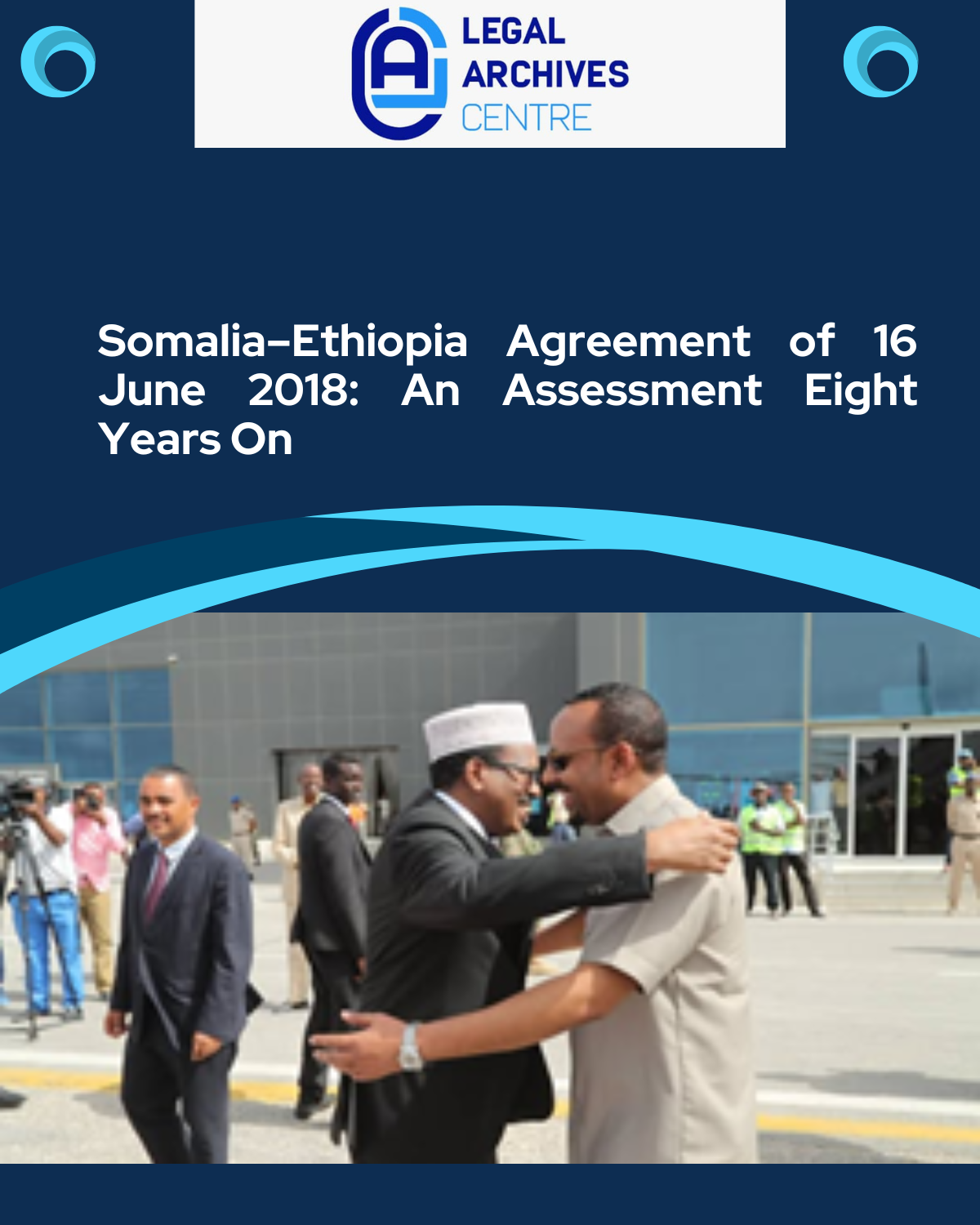
Nearly eight years after its conclusion, the 16 June 2018 Somalia–Ethiopia agreement appears to have produced limited practical results. While it envisaged joint investment in four Somali seaports alongside broader economic and strategic cooperation, subsequent developments suggest that these commitments did not crystallize into a stable and fully implemented framework.
However, relations deteriorated sharply in 2024 over Ethiopia’s Somaliland sea-access memorandum, prompting Somalia to denounce the move as a violation of its sovereignty. Only after Turkish mediation did the two states adopt the Ankara Declaration of 11 December 2024, reaffirming sovereignty, territorial integrity, and a cooperative approach to sea access, followed by renewed diplomatic engagement in 2025.
This sequence indicates that, while the 2018 agreement had diplomatic significance and temporarily improved bilateral relations, its long-term effectiveness in delivering the promised port, infrastructure, and strategic cooperation was constrained by later political and sovereignty disputes.
Somalia has concluded several bilateral instruments relating to specific aspects of maritime cooperation. Their formulation and implementation, however, have often lacked transparency and do not consistently appear to have been anchored in a stable conception of the national interest. Rather, such arrangements have at times seemed closely tied to the preferences of particular office-holders, with subsequent administrations moving to revoke or disregard them upon a change in political leadership.
This pattern has weakened continuity in maritime policy and has reduced the predictability of Somalia’s bilateral practice. The problem is compounded by the fact that a number of such instruments do not appear to have been formally published in the Official Gazette, thereby limiting public scrutiny and creating uncertainty as to their status, scope, and legal effect.
In 2016 and 2017, Somaliland and Puntland respectively concluded port agreements with DP World concerning Berbera and Bosaso. These arrangements were later rejected by the Federal Government of Somalia, and on 12 March 2018 the Federal Parliament voted overwhelmingly against the agreements, treating them as incompatible with Somalia’s sovereignty, territorial integrity, and federal authority over external relations.
The Provisional Constitution reserves foreign affairs and treaty-making to the Federal Government. Article 90(q) authorizes the President to sign international treaties proposed by the Council of Ministers and approved by the House of the People; Article 54 assigns foreign affairs to the Federal Government; and Article 51(4) prohibits any level of government from assuming powers beyond those conferred by the Constitution.
Somalia’s bilateral maritime practice has been marked by inconsistency and institutional dispute. The 2009 Kenya–Somalia maritime MoU was later repudiated by Somali authorities, notwithstanding the International Court of Justice’s subsequent recognition of it as an international agreement.
Likewise, port and related arrangements concluded by the United Arab Emirates with subnational entities without federal approval were later rejected by the Somali Parliament on 2018. reflecting the constitutional position that such engagements could not bypass the Federal Government.
On 12 January 2026, the Council of Ministers again annulled Somalia’s bilateral agreements and cooperative arrangements with the United Arab Emirates, citing concerns relating to sovereignty, territorial integrity, and political independence following the UAE’s reported facilitation of contacts between Israel and the self-declared Somaliland authorities.
In conclusion, Somalia’s bilateral maritime practice, including its arrangement with Ethiopia of 16 June 2018, reveals a pattern of legal and institutional fragility rather than sustained policy coherence. Although successive governments have entered into bilateral arrangements concerning ports, transport, boundary matters, and wider maritime cooperation, many of these instruments have not translated into durable and consistently implemented commitments.
The Somalia–Ethiopia arrangement, despite its political significance and its ambitious focus on seaports and infrastructure, ultimately produced limited practical results and was later overshadowed by renewed sovereignty disputes. Likewise, the repudiation, rejection, or annulment of other bilateral arrangements whether in relation to Kenya, DP World-linked port agreements, or the United Arab Emirates shows that Somalia’s maritime engagements have often remained vulnerable to constitutional contestation and political change.
This pattern is particularly significant in light of the constitutional framework, which clearly vests foreign affairs and treaty-making authority in the Federal Government. Where agreements are negotiated outside that framework, or are not formally published and integrated into a coherent national policy, their legitimacy and durability are readily called into question. As a result, Somalia’s bilateral maritime practice has been marked less by stable implementation than by recurrent disputes over competence, sovereignty, and legal authority.
Set out below is the bilateral agreement concluded between Somalia and Ethiopia.

No comment