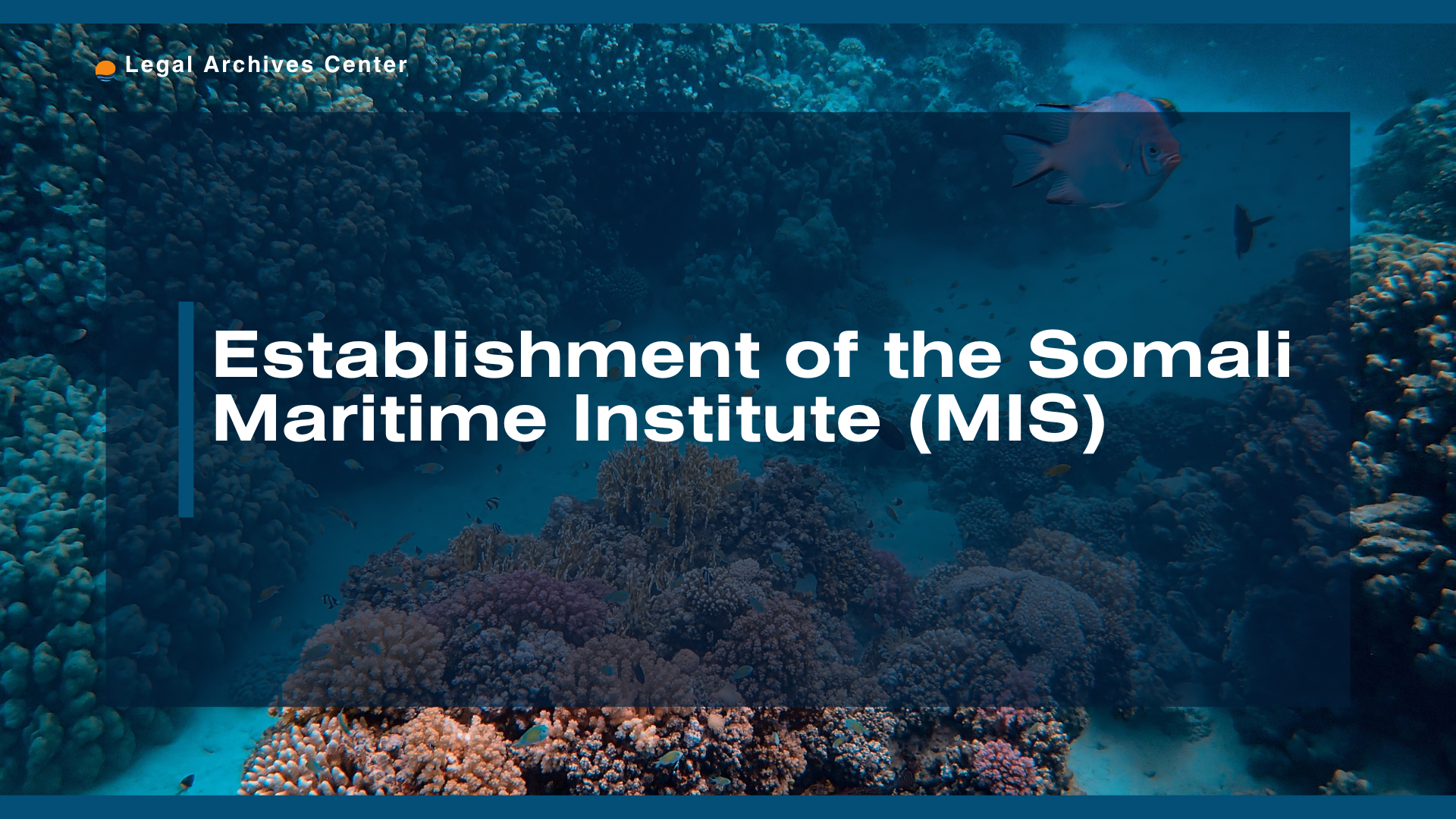
On 5 January 2026, the Council of Ministers of the Federal Government of Somalia approved the Law on the Establishment of the Somali Maritime Institute (MIS). The adoption of this law represents an important institutional step in strengthening Somalia’s maritime governance and developing national capacity in the maritime sector. Given Somalia’s strategic geographical position along one of the longest coastlines in Africa and its proximity to major international shipping routes in the Gulf of Aden and the Indian Ocean, the establishment of a national maritime training institution is considered essential for the sustainable development of the country’s maritime economy.
The Somali Maritime Institute is intended to function as a specialized national institution responsible for maritime education, professional training, and technical capacity building in fields related to maritime transport, port management, and ocean governance. One of the central objectives of the institute is to train Somali seafarers, maritime administrators, port professionals, and technical personnel in accordance with internationally recognized standards. In particular, the institute is expected to structure its training programmes in accordance with the standards set out in the International Convention on Standards of Training, Certification and Watchkeeping for Seafarers (STCW 1978), which establishes internationally recognized requirements for the training and certification of maritime personnel. Notably, this Convention was also approved by the Council of Ministers on the same date.
The creation of the Somali Maritime Institute also addresses a long-standing institutional gap in Somalia’s maritime sector. For many years, Somalia lacked a dedicated national maritime training center capable of preparing qualified maritime professionals. As a result, many Somali seafarers and maritime specialists were required to seek training abroad, often at significant financial cost. The establishment of MIS aims to reduce this dependency by creating domestic training opportunities and strengthening national expertise in maritime administration and maritime operations.
In addition to professional training, the institute is expected to contribute to research and policy development in the maritime field. Through academic programs, technical courses, and specialized research activities, the institute may support the development of national maritime policies related to port management, marine environmental protection, maritime security, fisheries governance, and maritime transportation systems. Such contributions are particularly important as Somalia continues to modernize its maritime legal framework and integrate into international maritime regulatory regimes.
The establishment of MIS also aligns with the broader reform agenda pursued by the Ministry of Ports and Maritime Transport, which has prioritized the modernization of Somalia’s maritime institutions, the adoption of international maritime conventions, and the strengthening of regulatory frameworks governing maritime activities. By developing a national training and research institution, the government aims to ensure that Somalia possesses the human capital necessary to effectively implement international maritime standards and manage its maritime resources responsibly.
Furthermore, the institute may play a crucial role in supporting employment opportunities for Somali youth, particularly in the maritime and shipping sectors. As global maritime trade continues to expand, the demand for trained seafarers, port operators, maritime engineers, and maritime administrators is increasing worldwide. Through structured education and certification programs, the Somali Maritime Institute has the potential to facilitate Somali participation in the international maritime labor market.
In this context, the approval of the Law on the Establishment of the Somali Maritime Institute represents a significant milestone in the institutional development of Somalia’s maritime sector. By creating a national center for maritime education and training, Somalia is taking an important step toward strengthening maritime governance, improving professional capacity, and supporting the long-term development of its maritime economy.
No comment