

Aldo Peronaci referred to in Somali historical memory as Alto Boronaajo was one of the key judicial figures during the formative years of the Somali Republic. His appointment marked an important transitional phase in Somalia’s early constitutional development, when the newly independent state still relied on foreign judicial expertise inherited from the Italian Trusteeship period.[1]
Peronaci’s tenure symbolized the bridge between the colonial-trusteeship legal legacy and the emerging Somali judicial identity. Although remembered as “the first” Chief Justice in Somali lists because he served at the top of the judiciary during the early independence decade his formal appointment date remains definitively fixed in 1965. After several years in office, he was succeeded by Somali jurists such as Abdirahman Sheikh Ali, marking the transition to full national leadership of the Supreme Court.
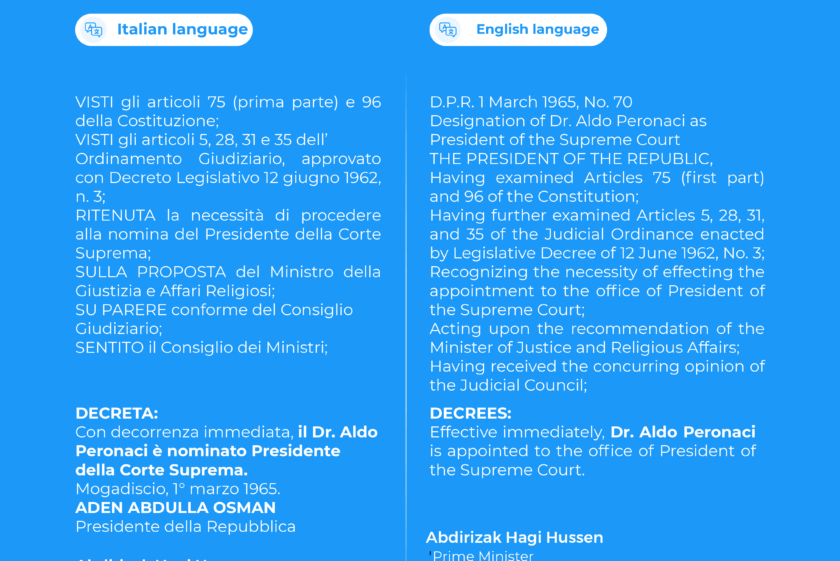
As Somalia navigated the institutional challenges following independence in 1960, the judicial system required experienced jurists to maintain continuity while Somali judges were being trained, promoted, and integrated into senior roles. In this context, the government of the Somali Republic formalized Peronaci’s leadership through Presidential Decree No. 70, issued on 1 March 1965 and signed by President Aden Abdulla Osman. The decree appointed Peronaci as President of the Supreme Court of Somalia, the highest judicial office in the nation. His appointment reflected the broader transitional policy of retaining a small number of foreign experts primarily Italian within the upper levels of the judiciary to ensure stability, administrative continuity, and technical guidance during the early years of state-building.
Aldo Peronaci’s contribution forms an important chapter in the institutional history of Somalia. His role illustrates how the early Republic blended inherited legal structures with new national aspirations, and how foreign expertise temporarily supported the establishment of domestic judicial capacity. Today, his appointment stands as a documented example of the complex legal transitions that characterized the 1960s, offering valuable insight for scholars examining the formation of judicial institutions in post-colonial states. The following is the presidential decree concerning Aldo Peronaci, presented here in its English translation from the original Italian text.
Below is a chronological list of the individuals who have served as Chief Justices of the Supreme Court of Somalia; –[2]
| No. | Name | Tenure |
| 1 | Alto Boronaajo (Italian ) | 1960 |
| 2 | Abdirahman Sheikh Ali Said | 1968 |
| 3 | Mohamud Sheikh Ahmed | 1969 |
| 4 | Ahmed Shire | 1974 |
| 5 | Hasan Abdullahi Farah | 1976 |
| 6 | Mohamed Axmed Xuseen | 1985 |
| 7 | Ahmed Hasan Ali Hasan | 1988 up to 1991 |
| 8 | Adan Gaab | 2000 |
| 9 | Sheikh Mohamud Sulaiman | 2002 |
| 10 | Yusuf Harun | 2004 |
| 11 | Mohamud Omar (Indhabuur) | 2007 up to 2011 |
| 12 | Aydiid Ilka Hanaf | 2011 up to 2016 |
| 13 | Ibraahim Iidle Sulaiman | 2016 up to 2018 |
| 14 | Bashe Yusuf Ahmed | 2018 (Current as of 2025) |
[1] Somalilandlaw, ‘The Somaliland Supreme (& Constitutional) Court’ (2015), available at http://www.somalilandlaw.com/somaliland_supreme_court.html.
[2] Caasimada Online, ‘List of the Chief Justices of Somalia, 1960–2018’ (Caasimada Online, 2018) https://www.caasimada.net/maxaa-ka-taqaanaa-guddoomiyayaashi-soo-maray-maxkamadda-sare-ee-dalka-1960-2018/#google_vignette. Accessed 30 November 2025.



No comment